Tuesday, 28 February 2017

Sunday, 26 February 2017
Single Camera Techniques
Jet from Chezney on Vimeo.
Camera: Shot Types
Shot types is the variety and different ways that the camera is positioned in, as well as the framing of the subject on screen. Shot types can vary from extreme close ups where the camera focuses completely on one specific body part, to an establishing shot which reveals the whole location without a character present.
 We can see the varied shot types being used at 2:34, here we see a close up of the characters hand turning the key in the ignition to follow the van that has stolen the girl. We further see another shot type being used at 3:05, in this scene we see a mid shot of the main character standing behind some trees, as he tries to look at the people getting out of the van. Moreover, this midst has allowed the audience to keep the focus on the main character i the foreground of the shot, whilst also revealing information in the background too.
Varying shot types allows for information to be revealed, in a more engaging way for the audience. By using a series of close-ups, mid-shots etc, allows for the scenes to flow together more creatively whilst also showing the continuity of the scene to the audience so that they dont have to think. Whilst many scenes could have been produced in a single long shot or mid shot, it would bore the audience, instead close-ups allow the audience to feel emotional and allow them to escape in the atmosphere of the films.
I have used varying shot types in my own work, more specifically in my music video. Through the narrative sections of our music video, we constantly cut between mid shots, close-ups to engage the audience through the story. We wanted to really portray a certain style and an overwhelming feeling of sadness for the character which could be achieved by the varying shot types that we used.
Lighting: Natural
Natural lighting, when the action uses natural sources for light such as the sun, to light the shot. Natural lighting can only be the sun or the moonlight to create light for the shot no man made lighting or artificial light can be used for the shot.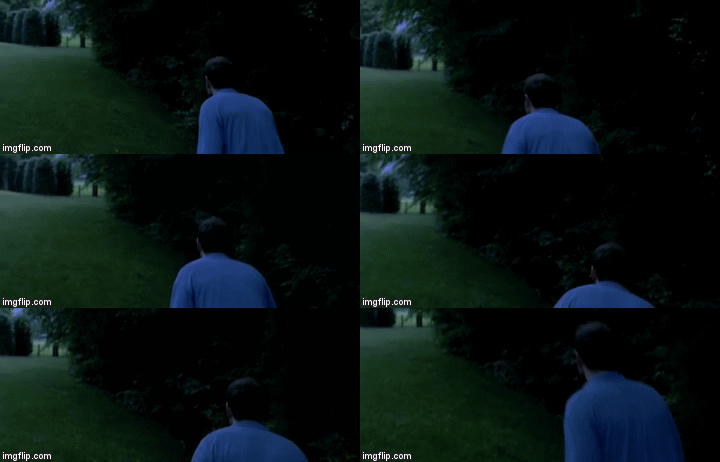
The use of natural lighting allows for the continuity of the scenes to flow more freely, it further extends the audiences ability to escape into the film rather then question things that they shouldn't need to. The natural lighting further allows for the filmmaker to reveal certain pieces of information and create meaning surrounding characters, for example by leaving the main character int he darker foreground it subconsciously makes the audience believe that they may become the dark character or do something which is very 'dark'.
I have used natural lighting during my ultra short film, during the crosscutting scene, as the dealer is walking to the park, the camera tracks from behind, using only natural light for the shot. As the scene was during midday, we could use the natural light keeping with continuity as we could later show the progression of the day as it got darker.
Sound: Tempo
Tempo is the speed in which the music or sound effect is playing at. Typically during horror's or thriller the tempo will start slow and increase to a high tempo to create intensity for the scene.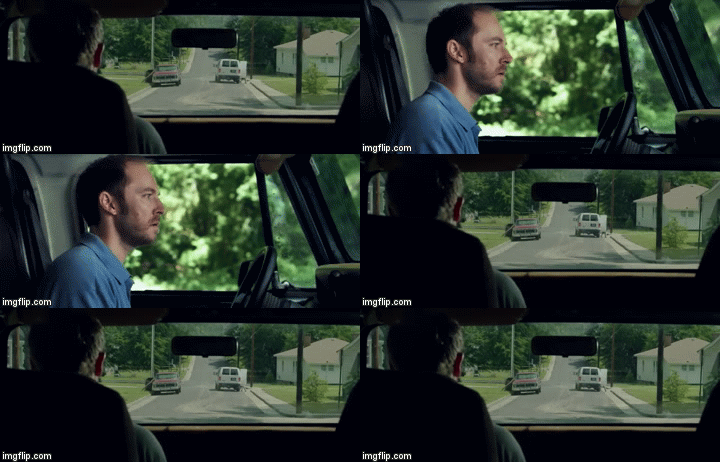 Typically thrillers will start off with a slow tempo and increase as the film goes on, to create an overwhelming intensity and atmosphere for the audience. However in this short film we see the at 2:03 the music begins, which is very slow but then at 2:45 is the point at which the tempo is at its highest. This perhaps differs from conventional the musics tempo does not increase as the film moves along but rather, reaches its peak early on whilst trying to maintain the level of atmosphere that it has already created through to the ending of the film.
For the filmmaker tempo is used to create atmosphere and heighten emotion of the scene. Tempo can kept in keeping with the speed of the transitions, as the filmmaker increases, the speed of cuts in the scene the tempo of the music can rise and thus making the audience feel overwhelmed. From an audience perspective, the tempo plays a big part in what we feel, it not only engages us but manipulates our response to the action on screen. Of course in this instance the music is used more differently, whilst it does speed up in some places there is not a gradual increase, but rather the filmmaker has fluctuated the tempo. This again creates a certain tension for the audience, as whilst it does not build us up to a big crescendo it does give a very eery tone for the audience throughout the whole film.
I have used tempo during my video on inspiration, in which the music started off very light and slow, the music then continued to build creating a more tense atmosphere for the audience. The music was at its fastest tempo as it was the most crucial part of the video, to which afterwards the music again slowed down and tailed off. This allowed me to make my audience feel so engaged, and focused on what was being said that afterwards there was almost a big release of emotion that the audience felt.
Editing: Color Grading
Colour grading is when the shots colours are changed purposefully to either correct what the camera didnt pick up or to create certain meanings through the different colours. Colour grading is used for aesthetics and to create meaning, eg, blue gives a cold sad meaning.
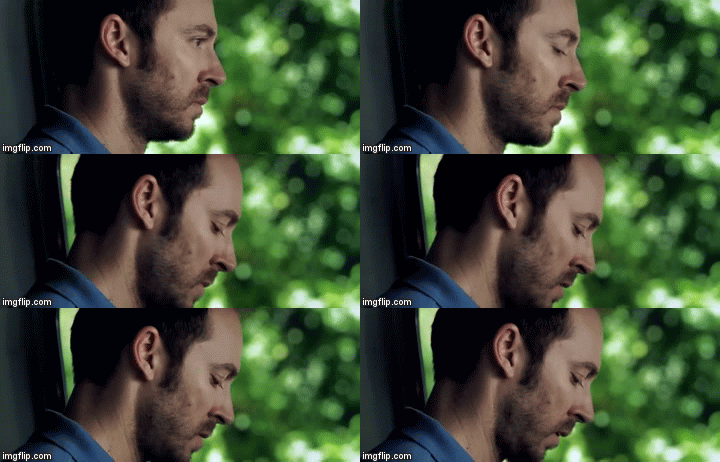 At 0:23 we see the use of colour grading being used, we see a close up, side on, of the main characters face in a deep thought, almost looking dejected. In terms of colour though we can see in the background which is heavily blurred that the trees are very vibrant, bright and almost have an enhanced feel to the green colour. In the foreground we see the mans face, naturally the colour grading is more of a natural look, we dont see a certain colour that dominates because we are just being introduced to the character. Equally just by looking at the top of his shirt we can see that the bull is very full in colour, it doesnt look flat in any way.
Colour grading creates a more full picture, whilst in many cases colour grading can highlight a certain colour which relates to an emotion in this film it is used more for realism. The filmmaker has allowed the colour grading to make many of the shots look more aesthetically pleasing, again relating back to the engagement of the audience. Whilst it is something that may consciously go unnoticed for the audience, if the film was not colour graded the audience perhaps would question the quality of the film.
I have used colour grading in my documentary on happiness. During the opening first shot of the documentary which was a piece to camera, when we first looked at the shot the colours seemed quite flat, however when we colour graded it we focused mainly on the mid tones of the shot, this made the shot look more vibrant and aesthetically pleasing to watch. The shot was made to look brighter, elevating the green that was in the shot as well as making myself look warmer.
Scripting: Expression & Body Language
Expression is a characters ability to portray emotion within the scene in a variety of different ways. Expression can stem from facial expressions, body and language or dialogue. Body language, is a type of expression, it is where the character will move their body in a certain way to portray emotion to the audience without using any dialogue or speech.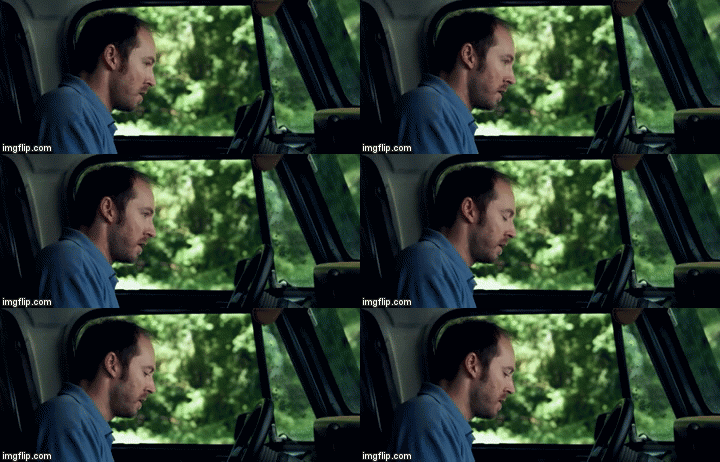 We see at 1:33 in a mid shot, side on, the main character couldn't pull the trigger to kill himself, as he has just lowered the gun he sits, hunched over and breathing very heavily. Whilst during this scene there is no dialogue or music, at this point his body language is the biggest sign of emotion for the audience.
As a filmmaker using body language perhaps creates more of a connection with the audience, it makes the audience feel very far apart from the character, which ultimately creates an even greater connection for the audience. By creating that distance the audience are manipulated into feeling an overwhelming sense of sympathy for the character thus positioning the audience on his side early on without actually knowing anything about him.
I used certain body language during a short film on Cyber bullying, this was a silent film, with just music playing. This meant that when acting i needed to produce more dramatic body language to really make a connection with the audience as well as emphasising the emotion i felt. The body language in a particular scene where i was crying, really allowed the audience to see a very raw form of emotion.
Building a Story: Realist
A realist story is a film that stays in the real world, it uses real world physics and is governed by real laws. This story type is realateable for the audience as it keeps the story in reality, and doesn't veer off into actions that are impossible. The film throughout uses a realist story, it is set in the real world and uses the physics and laws of the real world. This could be seen anywhere in the film, but at 1:57/2:00 we see the same long shot from the backseat of the car looking out at the road. As we see the white van pull up to snatch the girl, we can simply notice the break lights of the van as it stops. This in itself is an example of a realist story because the film is explicitly showing that the van has had to break and stop like any other car would have to do in order to kidnap the girl.
A realist story is used to give the sense of realism to the audience, it makes the audience feel that it is a story that could and can happen in real life. This further builds the tension for the audience, because now the film can be seen in a way that it is very plausible for the story to happen and perhaps if something is more achievable then the audience feel closer to it rather then having the excuse that it is make believe. Much like this film, which makes the audience understand and manipulate them into realising that this could have really happened, which is more scarier and more frightening for them rather then an anti-realist story in which they can easily deal with.
My ultra short film used a realist narrative, because we wanted the genre to be British Realism, which meant we need to have a narrative that really highlighted the gritty urban British life in order to stick to the genre. The realist story can really be seen when i was simply walking down the road, mainly because we wanted to include a setting and objects that the audience could really relate to, in this instance it was the red double-decker 86 bus.
Building a Scene: Climatic Ending
A climatic ending is where we see the content on its knife edge, it is where the audience consume a vast amount of information as there has been a whole build up to this final point. Climatic endings typically happen in a very fast paced fashion as there usually may be a fight scene or action scene of some sort.
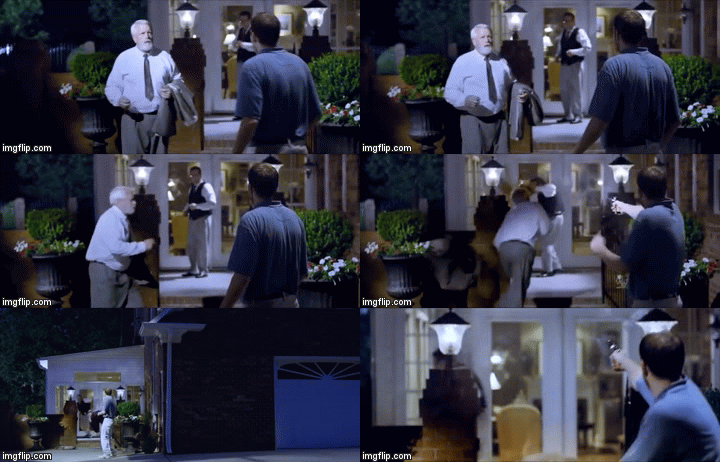
A climatic ending can be seen at 5:47, here we see the main character trying to go round the back of the house, to which he runs into two other characters leaving the house. In a long shot we see the main character shoot and kill the two other characters, and further run in to the house to find the girl. The film then ends in a close up of the mans face as he has killed two people, but the shot turns into a long shot of the girl sitting on a stool in the kitchen which ends the film.
For a filmmaker a climatic ending allows for the film to have a definitive end point, it allows the film to have a resolution at the end. A climatic ending also allows the audience to feel satisfied, often when films are left on a cliffhanger there perhaps is a distaste for the audience, however with a climatic ending there will always be an outcome which the audience can appreciate. However with this film Jet, the climatic ending is very sudden and even after it happens there is still one last scene that creates a cliffhanger for the audience. So whilst in this particular 'episode' there is an end point to the film, that final shot allows the audience to allude to something more that could potentially happen.
A climatic ending is something i haven't used yet. The films i have produced have mostly focused on an emotion or a situation which meant i couldn't build the film to a climatic ending. However i do aim to produce a film in the future based on society which i want to start from an idea and build to a big climatic ending which whilst may not resolve the issue of the film but certainly carries an end point which i hope gets the message of the film firmly across to my audience.
For a filmmaker a climatic ending allows for the film to have a definitive end point, it allows the film to have a resolution at the end. A climatic ending also allows the audience to feel satisfied, often when films are left on a cliffhanger there perhaps is a distaste for the audience, however with a climatic ending there will always be an outcome which the audience can appreciate. However with this film Jet, the climatic ending is very sudden and even after it happens there is still one last scene that creates a cliffhanger for the audience. So whilst in this particular 'episode' there is an end point to the film, that final shot allows the audience to allude to something more that could potentially happen.
A climatic ending is something i haven't used yet. The films i have produced have mostly focused on an emotion or a situation which meant i couldn't build the film to a climatic ending. However i do aim to produce a film in the future based on society which i want to start from an idea and build to a big climatic ending which whilst may not resolve the issue of the film but certainly carries an end point which i hope gets the message of the film firmly across to my audience.


Wednesday, 8 February 2017
Single Camera Narratives
Structures
Linear
A linear narrative structure, is the more conventional structure, it is where the programme starts from the beginning and flows all the way to the end. A linear sequence is a chronological order, that will reset every episode and generally always end in the same way too.At 0:26 we see a 2 shot of Will and Geoffrey at the front door of Wills new home as the camera further tracks both characters into the hallway. The shot denotes Will bursting through the door thinking that Geoffrey is Uncle Phil and gives him a hug. This shot is an example of a linear structure as the opening title sequence shows Wills backstory and ends with him at the front door of his Uncles house. To which the opening scene of the episode is a continuation of the title sequence as it too starts at the front door.
For the audience a linear structure is easy for them to follow, they don't have to think about the complexity of the programmes structure instead they can escape into the show and get away from their real life for a short period of time. Much like in the Fresh Prince of Bel Air, the audience didn't have to piece together what was going on because it was already played out for them. Furthermore, a linear structure is easier for the audience to anticipate what will happen next, we saw that Will got the wrong person, and can already expect that he will be corrected and introduced to Uncle Phil and the family in the next scene.
Non-linear
In contrast to a linear narrative, is a non-linear narrative, this is where the programme is more disjointed and will start any way they want to. A non-linear structure will not follow chronological order and as a result will not follow the causality pattern of events that a linear sequence would do.An example of a non-linear structure would be How i met your mother, this can be seen at 0:03. The shot denotes a point of view shot looking at 2 teenage kids, this features at the start of the episode and involves Ted talking to his Kids in the present day, telling them a story. This opening scene to the episode creates the non-linear structure, because they start in the present day but go back to the past to tell the story of how ted met his wife and their mother. Whilst the story may be told in a linear structure because there is this voiceover which addresses the episode in the past tense and starts in the present day highlights the non-linear structure.
From an audience perspective by using a non-linear structure, it creates a more complex narrative, for what may otherwise be very simple if it was produced using a linear sequence. Much like in How i met your mother, which is a story that could be told from start to finish, but by starting it in the present nd creating every episode to be a story in the past is more exciting for the audience. The non-linear structure also allows for a narrative arc to be brought across the episodes, e.g. in how i met your mother, some episodes will finish half way through a story, and carry on into a new episode such as; Marshal trying to make it to his wedding with Lily.
Flashback
A flashback narrative structure, is when the TV show interjects a scene from a characters past that cuts from the present day. A flashback sequence will often show the audience events that they either have already scene and need to be reminded of or events that they never knew about the characters past.One example of a flashback structure would be Blindspot, at 1:37 we see a low angle mid shot of the start of a flashback. The flashback is of an event that happened to Jane as she is recalling it to the NSA agent Nas, the shot denotes a CIA agent torturing Jane in a basement for information. Here a flashback is used to remind the audience of what has happened to Jane, as she is being interviewed the audience know she is telling the truth because the flashback makes us relive what happened.
One advantage of a flashback structure would be to add a sense of depth to the scene, and makes it more 'fuller.' Whilst this scene in Blindspot could be produced without flashbacks it would become more boring for the audience to watch because there is so much that could be done with a long conversation between two characters. But the flashbacks allow the audience to become more engaged as they can relive and feel the pain that Jane went through. Another advantage of flashbacks is the context that it provides, as Jane is talking the flashbacks just remind the audience of what happened, as the events that she talks about happened a long time ago.
Realist
A realist narrative structure, is simply where the world that the characters of the TV show live in obey and follow real world laws and rules, eg, gravity, physics etc. A realist narrative will live in the 'real' world and only do what could be done by any normal person.At 5:18 we see an example of a Realist narrative from Narcos. The shot denotes a shot-reverse-shot of Pablo and Graviria talking about Pablo handing himself in and going to prison at one of Pablos homes. The Realist structure is shown as they are simply standing in a field talking with the police on one side, and Pablos family and men on the other. Through this scene there are no continuity errors or anything that shouldn't be in the real world.
One advantage of a Realist narrative is that it makes the scene more believable, as this is a docudrama, there is no reason to add in anything that shouldn't be there. This programme is all about portraying what happened in Pablos life, so they need to be as accurate as possible. Another impact for the audience is that it creates a greater emotional impact for them, the audience can attach themselves more with the characters e.g. Pablo because everything is so real and believable. It makes it more real for us to watch and thus making us feel more invested in the characters and programme.
Anti-realist
In contrast to a Realist narrative structure is an Anti-realist structure, this is where the world created completely defies plausibility. It would often be used in horror films or TV programmes, as it will break and bend laws of physics, etc.An Anti-realist structure can be seen through The Walking Dead, here at 0:39 in this particular scene, it denotes a long shot of multiple 'walkers' walking along the road towards Rick and his team. This scene particularly highlights the programmes anti-relaist structure as they portray zombies, which can not be scene or created in the real world. This further illustrates that their world will have other differences and indiscrepancies that don't happen in the real world of a realist structure.
One impact of an anti-realist structure is that it generally more exciting for the audience. They can watch a programme that has no relevance to real life and can just sit and watch this Tv show at the end of their day. The walking dead is a programme that the audience can watch and invest their time in, and see what will happen to Rick and the gang every episode. Furthermore, this structure creates an escapism for the audience, they can immerse themselves within the programme and create an emotional tie with the characters, whilst not worrying about other things in their life. The walking dead is a 45 minutes programme that doesn't relate to real life allowing the audience to have a favourite character and create a relation with a character without having to focus on facts or a complex structure.
Endings
Open
An open ending is where the TV programme is left unfinished, this is where the scene has not yet ended but the episode has. An open ending leaves the programme on a cliffhanger meaning the following episode will most likely be a continuation and resolve the issue.One example of an open ending would be Game of thrones, At 4:21 we see the final scene of the episode and season, which is of a mid shot tracking in to close-up focusing on Jon Snow as he is presumably 'dead' after being stabbed multiple times. Whilst the scene tried hard to be a closed ending, the audience knew that this was not the last time we would see Jon Snow and thus in the next season episodes 1 & 2 was all about bringing Jon back to life.
An open ending holds a great deal of suspense for the audience, they are left with a cliffhanger, asking many questions about what is going to happen. Many dd not believe Jon Snow was actually dead and left the whole Game of Thrones fan base asking questions it was only until episode 2 that we got to see Jon come back to life. However an open ending creates spoilers and leaks, many websites tried to claim that they knew Jon was not dead and tried to leak pictures of him on set whilst others tried to spread false rumours. This of course is a negative impact for the structure but it does almost create a craze for the audience because they just have to know.
Closed
A closed ending however is the complete opposite, the narrative ends and the problem has been resolved allowing for the following episode to start fresh. By using a closed ending the TV programme would generally use Todorovs structure, and have a clear episodic narrative, which is often used for sitcoms or docudramas.A closed ending can be seen with Bobs burgers, this animated sitcom uses a closed ending and can be seen at 20:35. The shot denotes a mid shot of the whole family and captain on the boat, as the boat they are toeing goes up in flames containing all of the families personal belongings. At 20:51 the episode ends with a 2 shot of one boat exploding and the other driving away and out of the shot. This is the last shot of the episode and highlights how the issue of the episode has been resolved ready for another one in the next episode.
An impact of a closed structure would be that it is ultimately a more satisfying ending for the audience, they don't have to keep wondering and worrying about what will happen in the next episode because there is no narrative arc. Instead the audience can watch an episode of Bobs burgers, escape and laugh and end the episode feeling entertained ready for a new adventure in the coming episode. Lastly as a closed ending would typically be used with a linear structure, they further create an expectation by the audience. We now know how each episode will end and how the structure of the episodes are which means we can sit back and relax watching the episodes with out any major surprises.
Sunday, 5 February 2017
Formats of Single Camera Product
Formats
Series
A series TV show is a programme that runs for a set number of episodes typically airing once a week. A series show may further run for more then one series if there was a large popularity with the first series, and will normally create a narrative arc across the entire series perhaps in the form of an ongoing problem.Game of thrones would be an example of a TV series show, as it has 7 series or seasons, with 10 episodes in each series. Game of thrones has increased in popularity as the seasons have gone on, with season ones average viewers at 2.52 million compared to season 6 which was 7.69 million. we further see the narrative arcing across the seasons which can be seen at the end of season 5 Jon Snow dies, but it is only until episode 2 in season 6 that we see him come back to life.
One advantage of a series TV show would be, that the broadcaster will always get an audience, if the programme is popular then they when the series returns there will be a good rating as well as bringing in new viewers. Much like Game of thrones, the viewer ratings show that when the series returns it brought with it a bigger audience each time. Furthermore, by having a popular TV series, the broadcaster has the opportunity to feature a new show after, where by they will already have a big audience to watch it.
However, with a series whilst the audience and people involved making the show, whilst everyone wants it to keep continuing there has to be an end point. Much like the writers of game of thrones, David Benioff & D.B.Weiss who announced that game of thrones would finish after season 8. Moreover, with a series there maybe some narrative changes which the audience dont like and thus seeing a decrease in ratings. As such in Game of thrones, with Bran living in the tree, it was a controversial decision to leave him out of the season for a number of episodes, which caused some disappointment in the fans.
Serial
A serial TV show is one that runs for the entire year, it will air for the full 52 weeks of the year with often a low budget to maximise profits. Serials are different to series in the fact that they dont stop or take a break to record the next series, instead it is just one episode after another. One example of a serial Tv show would be Eastenders, which runs for 52 weeks of the year uninterrupted. The programme does not take breaks, instead they record produce release and do this every single week. The BBC produce Eastenders in quartets, which means that they start filming on a Tuesday taking nine days to record. This further means that in one day they can produce roughly 25-30 scenes, and can get as many as 12 episodes filmed within a matter of weeks. Eastenders annual cost in its first year of production was around 35 million but in the most recent year it has cost 29-30 million.
One advantage of a serial Tv show is the fact that it guarantees the broadcaster an audience. Each week the broadcaster will always know that an audience will be brought in by this serial, with Eastenders they bring in million of viewers each week and during some episodes such as the episode on the 2nd of January brought in 8.1 million viewers for the BBC. Another advantage would be that a serial is almost 'cheap & cheerful' in the sense that for what they cost is considerably less for what they bring in. If the BBC decides to air some programmes which may not be as well received, they will always know that they can full back on Eastenders to bring in the money that they may have lost.
Although, because serials do run for 52 weeks each year, it does become harder to constantly be creative. There is only so many times, characters in Eastenders can leave then comeback, or if there is a house fire, or explosion. Furthermore, the production is very long and hard, which this could reflect on some of the episodes. Perhaps some of the early episodes in Eastenders are a lot better performed then some later ones in the year.
Single Drama
Single Drama's are a one time TV programme, they do not have a series or spin off afterwards but rather left as just one programme. Single Drama's typically have a high budget as they need to tell the narrative through a single show, which also means that they last longer then the typical TV show. Single Drama's in fact last between 90 mins to 120 mins.
Please don't take my baby would be an example of a TV single drama, as it was a one off programme filmed in 2 locations, a hospital in middlesex and some studios in london. Whilst the programme did only have a run time of 60 mins it did not have a carry on of another episode on the same subject.
One advantage of a single drama is that it does bring something new and fresh to the channel and broadcaster. Please don't take my baby does was a BBC exclusive which again added to the originality of BBC 3 which continues to aim and produce some eccentric single dramas. Furthermore, it is a bigger novelty for the channel to have these single dramas which can form how they want the audience to perceive them and further allows for an audience to be brought in and watch these more different, niche single dramas that cant be seen any where else, much like please don't take my baby.
However Single dramas don't typically bring in a big audience because they are not publicised as well. Please don't take my baby whilst was a very emotional single drama was not advertised much and so not many people actually knew to watch it. Thus these single drams tend to pick up viewers across a long period of time because an audience will stumble across the programme. Moreover, the single dramas do have a lot of resources invested in them, they have to tell a narrative in one single programme which can cost a lot. Please don't take my baby although maybe one of the more simple single dramas to produce, still cost a great deal to make, which raises the question if it is worth producing it.
Please don't take my baby would be an example of a TV single drama, as it was a one off programme filmed in 2 locations, a hospital in middlesex and some studios in london. Whilst the programme did only have a run time of 60 mins it did not have a carry on of another episode on the same subject.
One advantage of a single drama is that it does bring something new and fresh to the channel and broadcaster. Please don't take my baby does was a BBC exclusive which again added to the originality of BBC 3 which continues to aim and produce some eccentric single dramas. Furthermore, it is a bigger novelty for the channel to have these single dramas which can form how they want the audience to perceive them and further allows for an audience to be brought in and watch these more different, niche single dramas that cant be seen any where else, much like please don't take my baby.
However Single dramas don't typically bring in a big audience because they are not publicised as well. Please don't take my baby whilst was a very emotional single drama was not advertised much and so not many people actually knew to watch it. Thus these single drams tend to pick up viewers across a long period of time because an audience will stumble across the programme. Moreover, the single dramas do have a lot of resources invested in them, they have to tell a narrative in one single programme which can cost a lot. Please don't take my baby although maybe one of the more simple single dramas to produce, still cost a great deal to make, which raises the question if it is worth producing it.
Genres
Period
Period dramas, are typically TV shows that are set in the past, during a certain time period. Periods, tend to have a high cost for the mise-en-scene to set the particular style hat they need. Moreover, Period drama will be shot on location as often as possible and deliberately try to use simple yet specific camera movements.
The Pacific would be an example of a period drama as it was made in 2010 yet it tells the stories of the 2nd World War. The pacific took over $200 million to produce the series of 10 episodes in this period drama. The pacific was filmed for 1 year all across Australia to get the right mies-en-scene for the various battles that were portrayed in the series.
At 0:14 we see a long shot of the battle field, with the soldiers falling and trying to escape from the on coming fire. The camera is constantly shaking to add this heightened anxiety tone to the scene. The shot allows the audience to see the scale of the battle, whilst they are made to feel sympathy for the enormity of whats happening, they are further made to feel this heightened anxiety as they see soldiers dropping down dead. The shakiness of the camera extends the emotion that the audience are made to feel, whilst more specifically making them feel this very raw sense of reality and engagement because it almost seems like amateur filming.
At 1:10 we further see a close up of a soldiers leg being blown off, whilst the edit is quick to cut away, it does linger for a second to allow for this very gory visual, with the blood squirting out. The close up allows for the scene to carry a sinister horror tone with it, as we do get to see a lot of the blood squirting out. As the audience are made to see this violent visual, they are manipulated to initially feel this overwhelming sense of shock, but secondly are made to feel this sense of reality because it is something that happened during the war. The fast pace editing though does move the audience swiftly along and taking their attention to something else happening, again adding to this overwhelming feeling.
Lastly at 1:17 we see this single solider, standing alone in a crowd of fallen bodies, he is covered in dirt and blood, which is pouring down the side of his head, as well as his hand being blown off. The camera then further tracks him falling down dead, as the scene carries on. The edit decides to dwell on this single solider, fighting to stay alive and keep moving, but we see him fall loosing hope and the battle. The audience are almost made to feel nothing but sadness and sympathy for this solider that we never got to meet, but almost feel the closest person to him. The audience are manipulated into feeling nothing but hopelessness as we can do nothing to help him, this picture is almost the pinnacle of emotion for the audience as they are totally overwhelmed at this point. It perhaps is the saddest part of this montage, as it almost sums up everything that was wrong with the war.
The Pacific would be an example of a period drama as it was made in 2010 yet it tells the stories of the 2nd World War. The pacific took over $200 million to produce the series of 10 episodes in this period drama. The pacific was filmed for 1 year all across Australia to get the right mies-en-scene for the various battles that were portrayed in the series.
At 0:14 we see a long shot of the battle field, with the soldiers falling and trying to escape from the on coming fire. The camera is constantly shaking to add this heightened anxiety tone to the scene. The shot allows the audience to see the scale of the battle, whilst they are made to feel sympathy for the enormity of whats happening, they are further made to feel this heightened anxiety as they see soldiers dropping down dead. The shakiness of the camera extends the emotion that the audience are made to feel, whilst more specifically making them feel this very raw sense of reality and engagement because it almost seems like amateur filming.
At 1:10 we further see a close up of a soldiers leg being blown off, whilst the edit is quick to cut away, it does linger for a second to allow for this very gory visual, with the blood squirting out. The close up allows for the scene to carry a sinister horror tone with it, as we do get to see a lot of the blood squirting out. As the audience are made to see this violent visual, they are manipulated to initially feel this overwhelming sense of shock, but secondly are made to feel this sense of reality because it is something that happened during the war. The fast pace editing though does move the audience swiftly along and taking their attention to something else happening, again adding to this overwhelming feeling.
Lastly at 1:17 we see this single solider, standing alone in a crowd of fallen bodies, he is covered in dirt and blood, which is pouring down the side of his head, as well as his hand being blown off. The camera then further tracks him falling down dead, as the scene carries on. The edit decides to dwell on this single solider, fighting to stay alive and keep moving, but we see him fall loosing hope and the battle. The audience are almost made to feel nothing but sadness and sympathy for this solider that we never got to meet, but almost feel the closest person to him. The audience are manipulated into feeling nothing but hopelessness as we can do nothing to help him, this picture is almost the pinnacle of emotion for the audience as they are totally overwhelmed at this point. It perhaps is the saddest part of this montage, as it almost sums up everything that was wrong with the war.
Dramadoc
Drama-docs are TV programmes that feature, real life events but in a more exaggerated, dramatised way. Whilst they try to stick close to the real stories, they do twist it slightly to add either a film or documentary style.
At 1:30 we see low angle, mid shot of Pablo standing in the doorway as the general talks to him. The low angle is used to make pablo look big, it promotes power and makes the audience see that pablo didn't care who he was talking to he did and said what he wanted. The mid shot extends this position of power as the audience can see that he doesn't have to walk straight to the generals desk, instead he stands in a controlling position. This is where he can choose to either walk in further and slower or he could walk out, either way the shot gives Pablo the choice and not the law.
Furthermore, at 2:32 we see the close up Pablo's face as the episode and season is coming to the end. The Close up puts the whole focus on Pablo as well as leaving him in a field where there is no other subject but himself. The shot type allows the audience to perhaps see the greatness of the man at this stage in his life. We can see that at the moment Pablo is in the best position he has ever been and we end up first seeing the empire that this man has created but moreover, the fall that is to come for this man.
Lastly at 6:48 we see a long shot tracking out, which depicts 4 dead men being strung up on a tree with a message posted on the tree. The edit first kept the camera on Pablo as he was taking pictures, the camera then cut and exhibited this big reveal of what he was taking pictures of. This shot makes the audience see the madness that has come to this man and the cartel. Whilst throughout the programme the audience are made to keep thinking they have seen the worst of Pablo, we next see this. Whilst we should be used to the brutality of the cartel, somehow the audience are still shocked of what Pablo does. Perhaps this shot is the crux of the madness that Pablo has achieved, at this point he has lost control and the audience somewhat can never fully understand the extent of the lengths he will go to.
At 1:30 we see low angle, mid shot of Pablo standing in the doorway as the general talks to him. The low angle is used to make pablo look big, it promotes power and makes the audience see that pablo didn't care who he was talking to he did and said what he wanted. The mid shot extends this position of power as the audience can see that he doesn't have to walk straight to the generals desk, instead he stands in a controlling position. This is where he can choose to either walk in further and slower or he could walk out, either way the shot gives Pablo the choice and not the law.
Furthermore, at 2:32 we see the close up Pablo's face as the episode and season is coming to the end. The Close up puts the whole focus on Pablo as well as leaving him in a field where there is no other subject but himself. The shot type allows the audience to perhaps see the greatness of the man at this stage in his life. We can see that at the moment Pablo is in the best position he has ever been and we end up first seeing the empire that this man has created but moreover, the fall that is to come for this man.
Lastly at 6:48 we see a long shot tracking out, which depicts 4 dead men being strung up on a tree with a message posted on the tree. The edit first kept the camera on Pablo as he was taking pictures, the camera then cut and exhibited this big reveal of what he was taking pictures of. This shot makes the audience see the madness that has come to this man and the cartel. Whilst throughout the programme the audience are made to keep thinking they have seen the worst of Pablo, we next see this. Whilst we should be used to the brutality of the cartel, somehow the audience are still shocked of what Pablo does. Perhaps this shot is the crux of the madness that Pablo has achieved, at this point he has lost control and the audience somewhat can never fully understand the extent of the lengths he will go to.
Crime
The crime genre is where the programme is based all around criminal activity, this can stem from a a main base of criminal characters that continue to perform criminal acts or perhaps the same end point that detectives would have to work back from and find the criminals. Most crime shows will follow the detectives or policing organisation rather then the criminals themselves, although there maybe certain episodes where we will follow the criminals.
At 0:12 we see a close up of the characters hand as it highlights the ring he is wearing, the shot becomes more significant when the audience realise that the ring had been brought up prior to the episode. Through this shot the audience are made to be on Patersons side, as she has discovered that was the mole within the FBI. Moreover, the audience can further expect to see a tense confrontational scene between both characters which will result in sme sort of violence. The scene prior to this shot had a more slower editing pace, but as it cuts into this close up there is a signifcant increase in edit pace. This in turn makes the audience feel a surge of anexiety and keeps them on edge as we move into the big climax of the episode.
Furthermore, at 0:28 we again see a close up which is used to evoke more of an emotional esponse in the audience. As we now see the facial expression and reactions to Paterson finding out the secret, cutting back to Borden's face as he has just been caught. The close up manipulates the audiences emotional response as they now have to watch him lie to her face, this in turn makes us feel a real sense of loyalty to Paterson and a great dislike to Borden .
Lastly at 4:20 we see a series of fast paced close ups of the 2 characters almost in a shot-reverse-shot. This is the final scene of the episode and the episode is ending with a big climax to see who gets shot. This shot denotes, a close up of Paterson's face in shock, the edit then cuts back and fourth from Paterson's face to Borden's as they both give off the same reaction making the ending of the episode very ambiguous. By using a series of fast close-ups, it allows for the ambiguity to be created, the audience now do not know who has been shot, leaving the episode open and on a cliffhanger. The audience are made to feel a great sense of horror and shock. This shot further entices the adience and makes them have to come back for the next episode, because they are emotionally invested they now 'need' to see the end point.
At 0:12 we see a close up of the characters hand as it highlights the ring he is wearing, the shot becomes more significant when the audience realise that the ring had been brought up prior to the episode. Through this shot the audience are made to be on Patersons side, as she has discovered that was the mole within the FBI. Moreover, the audience can further expect to see a tense confrontational scene between both characters which will result in sme sort of violence. The scene prior to this shot had a more slower editing pace, but as it cuts into this close up there is a signifcant increase in edit pace. This in turn makes the audience feel a surge of anexiety and keeps them on edge as we move into the big climax of the episode.
Furthermore, at 0:28 we again see a close up which is used to evoke more of an emotional esponse in the audience. As we now see the facial expression and reactions to Paterson finding out the secret, cutting back to Borden's face as he has just been caught. The close up manipulates the audiences emotional response as they now have to watch him lie to her face, this in turn makes us feel a real sense of loyalty to Paterson and a great dislike to Borden .
Lastly at 4:20 we see a series of fast paced close ups of the 2 characters almost in a shot-reverse-shot. This is the final scene of the episode and the episode is ending with a big climax to see who gets shot. This shot denotes, a close up of Paterson's face in shock, the edit then cuts back and fourth from Paterson's face to Borden's as they both give off the same reaction making the ending of the episode very ambiguous. By using a series of fast close-ups, it allows for the ambiguity to be created, the audience now do not know who has been shot, leaving the episode open and on a cliffhanger. The audience are made to feel a great sense of horror and shock. This shot further entices the adience and makes them have to come back for the next episode, because they are emotionally invested they now 'need' to see the end point.
Soap Opera
Soap operas, are a melodramatic, exaggerated world, that tries to deal with real life problems each week. Soaps are set in the present day often keeping the same permanent set that the programme revolves around.
At 1:27 we see a long shot of someones feet, the camera then pans up to reveal a new attractive girl that the audience would have never seen before. The shot denotes a match on action at the start as the ball rolls over to her feet she then stops the ball and the camera starts to pan up to reveal who she is, the scene takes place in front of the school before school has started. The shot puts a real emphasis on the subject, whilst at the start we don't necessarily think that it will be anything special, the camera movement engages the audience more because we now know that there is a reveal about to happen. The long shot further makes the audience focus fully on her and really take in the detail of her. This reveal makes the audience understand that this character will be special in the coming episodes because it does dwell on her for a longer time.
Furthermore, at 3:50 the shot denotes a close up of a girls elbow breaking the window at the front of the school. The scene denotes 2 characters who we have never met before, but seem to have a history together, which the audience understand that they both will play a bigger role. Whilst the edit pace does increase, the scene actually cuts to 3 separate shots in quick sucsession of her elbow smashing through the glass. Whilst from an audience perspective, we get to see some action very early on in the episode which initially grabs us.
Moreover, at 7:51 the shot denotes a 2 shot of the headteacher and new assistant head, whilst in the foreground of the shot there is one of the main characters from the previous scenes, although she is slightly blurred. The shot allows the 2 teachers to have a conversation talking about a specific incident or student but not specifically saying their name. Equally the audience understand the context of the conversation but we don't know whether the assistant head will tell the truth or lie and when we do see that she lies the audience gain a respect for her. The shot further allows the audience to see the emotion of the characters more, we can see the expressions of the student and the role that the assistant head may play in the future.
At 1:27 we see a long shot of someones feet, the camera then pans up to reveal a new attractive girl that the audience would have never seen before. The shot denotes a match on action at the start as the ball rolls over to her feet she then stops the ball and the camera starts to pan up to reveal who she is, the scene takes place in front of the school before school has started. The shot puts a real emphasis on the subject, whilst at the start we don't necessarily think that it will be anything special, the camera movement engages the audience more because we now know that there is a reveal about to happen. The long shot further makes the audience focus fully on her and really take in the detail of her. This reveal makes the audience understand that this character will be special in the coming episodes because it does dwell on her for a longer time.
Furthermore, at 3:50 the shot denotes a close up of a girls elbow breaking the window at the front of the school. The scene denotes 2 characters who we have never met before, but seem to have a history together, which the audience understand that they both will play a bigger role. Whilst the edit pace does increase, the scene actually cuts to 3 separate shots in quick sucsession of her elbow smashing through the glass. Whilst from an audience perspective, we get to see some action very early on in the episode which initially grabs us.
Moreover, at 7:51 the shot denotes a 2 shot of the headteacher and new assistant head, whilst in the foreground of the shot there is one of the main characters from the previous scenes, although she is slightly blurred. The shot allows the 2 teachers to have a conversation talking about a specific incident or student but not specifically saying their name. Equally the audience understand the context of the conversation but we don't know whether the assistant head will tell the truth or lie and when we do see that she lies the audience gain a respect for her. The shot further allows the audience to see the emotion of the characters more, we can see the expressions of the student and the role that the assistant head may play in the future.
Comedy
Comedy TV show often come in the form of sitcoms, which are a 30 minute episode, with a small and simple character base able to easily relate to its target audience. Sitcoms will further have a problem each episode that needs to be resolved and very rarely will the dilemma continue into another episode.At 0:02 we see a mid shot in slow motion of Barry Goldberg walking into school, dressed as Boy George going to meet up with his girlfriend and sister. The purpose of the mid shot is to firstly frame Barry in the center to create a more humorous tone as the audience can absorb what he is wearing, and secondly it allows for more action ot happen in the background and see the other students laugh at him. This therefore makes the audience laugh at him because we understand that the stupidness of his actions. However at this point we may feel some sympathy for him because we still know that Barry is a very naive person with the right intentions. Moreover the slow motion again adds to the comical effect. The slow motion allows for the shot to become a lot longer, which connotes how everyone is mocking Barry. Furthermore, the slow motion gives the audience permission to laugh at him as well, because the slow motion lingers on him so can we.
Next we see this continuation of mockery of Barry as now he interacting with other students, at 0:10 there is a 2 shot, which shows a character that Barry has just said hi to, as well as another student standing talking. The shot connotes Barry saying hi to another student to which the edit then cuts to the student Barry was talking to and will then cut back to Barry. By allowing the visual to follow the audio is primarily allows the audience to easily see whats happening and who is being talked too. But secondly the audience are forced to see other students reactions of Barry, which exhibits how everyone thinks he looks Stupid. Again by showing this cameo character we can compare Barry to other students and can really see far down he is regarded at this point. Lastly as with the majority of the opening to this scene, the edit pace is again in slow motion which allows the audience to again laugh at Barry.
Lastly at 0:54 we see a shot reverse shot which denotes Barry talking to Laniey about their relationship and how she fooled him into tricking and humiliating him because he has been too 'needy' as of late. The shot further sees Barry say Boy George Quotes to make Lainey feel guilty for what she did. Whilst the shot is a simple stationary shot-reverse-shot it is done with pace, which extends the humor of this scene. As it is fast not only does it allow Barry to say more quotes, it shows Lainey to be very embarrassed that he would go to such lengths of idiocy. From an audience perspective we side with Lainey and feel the levels of cringe and embarrassment that Barry has just put us through, whilst there is a small part that does feel sympathy for Barry is is greatly over powered by the laughing stock that Barry has made himself.
Subscribe to:
Posts (Atom)